

Key points of this blog
- AI decisions introduce new attack paths. Research shows how manipulated information can influence models and agents, with potential consequences depending on their integration with vehicle functions.
- AIDV risks need clear ownership across organizational boundaries. OEMs and suppliers must coordinate assessments and assign responsibility for risks spanning safety, cybersecurity, and AI development.
- Securing AIDVs means following decisions through to actions. Threat modeling traces how manipulated information could affect vehicle behavior and identifies where controls must prevent unauthorized or unsafe actions.
What happens when an attacker influences the information a model uses to decide how a vehicle should move?
In May 2026, researchers explored that question in the ReasonBreak study. Using corrupted textual inputs, they manipulated trajectories generated by NVIDIA’s Alpamayo driving models, increasing collision rates in closed-loop simulation. The study exposes a security concern tied to the capability driving AI adoption: models interpreting information and using it to guide actions.
Part 1, “AI-Defined Vehicles: Practical Gains and Implications for Automotive Cybersecurity,” explored how that capability is entering vehicle architectures and development workflows. This second part examines what those capabilities demand of cybersecurity in AI-defined vehicles (AIDVs) and how OEMs and suppliers can respond.
How attackers can manipulate driving models
Attackers targeting AI-defined vehicles do not always need to alter a model’s code or weights to influence its outputs. Models that combine visual observations with language introduce input channels through which manipulated information can affect driving decisions. Three attack vectors from recent research illustrate the range of techniques and their potential consequences.
Altered text can change generated driving trajectories
In the ReasonBreak study, researchers queried the target models and altered textual inputs without accessing their internal parameters. Changes to spelling, capitalization, and character composition affected reasoning and trajectory generation while visual inputs remained unchanged. In closed-loop simulation, trajectory manipulation attacks achieved up to a 72% success rate against Alpamayo 1 under the study’s evaluation criteria. These are research results in simulation, not evidence of a demonstrated exploit against a production vehicle.
Manipulated visual inputs can influence physical actions
A study of black-box adversarial attacks on driving models tested patches designed to disrupt how vision-language models interpret driving scenes. Physical experiments used small robotic research vehicles on a constructed track, with language models configured to translate observations into driving commands. The authors reported reduced route completion and collisions with an obstacle vehicle. The findings demonstrate physical effects in research vehicles, rather than production passenger vehicles.
Attacks can also target response time
In a reflection-based backdoor study, researchers poisoned part of the DriveLM training dataset with faint reflection patterns added to selected images and lengthy, irrelevant prefixes added to the corresponding text labels. Models fine-tuned on that data performed normally on clean inputs but generated abnormally long responses when the visual trigger appeared, increasing inference latency.
Key implication: Security evaluation of driving models must consider response time alongside output accuracy. In a time-constrained driving stack, a model that responds correctly but too slowly under adversarial conditions could still contribute to unsafe vehicle behavior, depending on the system’s timing budget and fallback mechanisms.
How AI model supply chains introduce risks before vehicle deployment
A model’s behavior depends partly on decisions made before it reaches an automaker: which data was collected, how it was trained or fine-tuned, and how its files were distributed. Each stage introduces dependencies that downstream teams must assess before deployment.
“As vehicles become AI-defined, compromised training data introduces a persistent risk that can shape vehicle behavior across generations and cannot be easily remediated.”
- VicOne’s 2026 Automotive Cybersecurity Report
Three supply-chain attack vectors have been demonstrated in research settings:
- Training data poisoned before it reaches developers. Research on poisoning web-scale datasets demonstrated techniques that change online content between dataset inclusion and download, or insert malicious content shortly before a scheduled collection.
- Malicious code embedded in model files. Researchers found malicious model files on Hugging Face that evaded the platform’s scanning mechanisms at the time and contained code that could execute during loading.
- Namespace reuse pointing to attacker-controlled models. Researchers demonstrated model namespace reuse by re-registering an abandoned publisher name. They found models whose original publisher accounts had been deleted still listed for deployment in Google Vertex AI and Azure AI Foundry catalogs.
Depending on how data or models were reused, remediation may require identifying affected versions and vehicle functions, retraining or replacing models, and repeating validation. That makes model sourcing a procurement and engineering responsibility. Models making vehicle decisions deserve scrutiny comparable to hardware and ECU suppliers.
How agent permissions determine the impact of an attack
An AI agent can retrieve information, invoke tools, and act through connected services. Those permissions also determine what an attacker could reach through indirect prompt injection, where malicious instructions embedded in content redirect the agent’s behavior.
Research on productivity assistants and developer tools shows how this plays out in practice:
Untrusted content can redirect an assistant
Microsoft documented CVE-2025-32711, an AI command-injection vulnerability in Microsoft 365 Copilot that allowed an unauthorized attacker to disclose information over a network. Microsoft rated it Critical, with a CVSS 3.1 score of 9.3; NVD lists its own score of 7.5 (High). In another example, research on Gemini-powered assistants demonstrated 14 attack scenarios, including data exfiltration and home automation control. Using a threat analysis and risk assessment (TARA) framework adapted from ISO/SAE 21434, the authors classified 73% of the analyzed threats as high or critical before mitigation. Google deployed mitigations following disclosure.
Visual review can miss instructions the agent processes
Zenity demonstrated a prompt concealed in white one-pixel text inside a document shared with ChatGPT through its Connectors feature. The instructions caused ChatGPT to retrieve and exfiltrate sensitive information from a connected cloud-storage account.
Legitimate tools can carry out unintended actions
In a GitHub Model Context Protocol (MCP) demonstration, malicious instructions in a public issue caused an agent to retrieve private repository data and publish it in a public pull request. The attack used legitimate tools and existing permissions, making approval settings and restrictions on data movement important.
Retained memory can preserve an attacker’s influence
A Gemini memory poisoning demonstration embedded instructions in a document and delayed a memory write until the user gave an ordinary conversational response, such as “yes.” Attacker-chosen information then entered persistent memory, potentially influencing later sessions.
What this means for AI agents
While these findings concern non-automotive systems, VicOne’s analysis of prompt injection in vehicle systems illustrates how a similar attack could unfold inside a vehicle. A driver asks an assistant to read a message containing malicious instructions concealed with invisible Unicode characters. Whether those instructions lead to unauthorized actions depends on the agent’s access and the controls enforced by the systems receiving its requests.
Security assessments must therefore examine which inputs can influence an agent, which functions it can access, and where authorization is enforced before its requests become actions.
Who owns cybersecurity risks in AI-defined vehicles?
Assessing AIDVs draws on automotive cybersecurity, AI safety, software updates, and supplier governance. These areas address related concerns from different perspectives. When organizations manage them separately, risks can fall between assessments.
A model that responds too slowly illustrates the overlap.
ISO/PAS 8800:2024 addresses safety-related AI output insufficiencies, while ISO/IEC 27090:2026 addresses threats such as data poisoning. A deliberately trained backdoor that delays a driving model’s response crosses both concerns. Similar overlaps arise across the AI life cycle.
The table below maps the relevant frameworks, their coverage limits, and the responsibilities that need an accountable owner.
| Concern | Relevant standards and practices | Coverage and ownership limits | Accountability to assign |
|---|---|---|---|
| Model insufficiency as a safety hazard | ISO/PAS 8800:2024 | Automotive AI safety is addressed; deliberate manipulation also needs cybersecurity assessment. | OEM connects safety and security findings; suppliers provide component evidence. |
| Model provenance and signing | ISO/SAE 21434 supplier processes; OpenSSF Model Signing | Signing supports origin and integrity verification; it does not establish secure or robust behavior. | Suppliers authenticate artifacts; integration teams verify provenance and behavior. |
| Training-data integrity | ISO/IEC 27090:2026; ISO/SAE 21434 | AI security guidance exists; downstream exposure requires vehicle-specific tracing. | Model suppliers document training history; OEM traces affected vehicle functions. |
| Prompt injection | OWASP LLM01:2025; ISO/SAE 21434 risk assessment | General guidance needs testing against vehicle integrations and input channels. | Agent developers and integration teams test the input-to-action path. |
| Agent authority and least privilege | OWASP LLM06:2025; cybersecurity architecture controls | Model instructions cannot substitute for downstream authorization. | OEM defines permitted actions; system owners enforce access boundaries. |
| Model insufficiency as a security threat | ISO/SAE 21434; ISO/IEC 27090:2026 | Exploitable model weaknesses can fall between performance and security assessments. | AI and cybersecurity teams jointly assess exploitation and consequences. |
| Post-deployment model and software updates | UN R156; change-management processes | Assessment and approval implications depend on the update’s effect on regulated vehicle functions and safety. | OEM coordinates change assessment, approval decisions, and revalidation. |
| AI incident forensics and audit trail | UN R155 CSMS; cybersecurity monitoring and incident-response processes | Model versions alone may not explain inputs, context, or actions. | OEM defines evidence needs; suppliers and operations teams maintain records. |
| AI-generated code in a safety case | Applicable software and tool-assurance processes | ISO/PAS 8800 does not provide specific guidance for AI-based software tools. | Engineering and tool owners validate outputs supporting the safety case. |
| AI in vehicles, as a regulatory subject | UN R155/R156; applicable EU AI Act provisions | Obligations depend on function and classification; cross-team coordination remains essential. | OEM coordinates applicable obligations and assigns supplier responsibilities. |
Table 1. AI-related vehicle security concerns, framework coverage limits, and proposed responsibilities for OEMs and suppliers
OEMs must coordinate AI risk at the vehicle level, with suppliers accountable for their components and supporting evidence. Established practices should be supplemented with AI-specific risk frameworks that address model integrity, data poisoning, explainability, and safety degradation over time.
Five actions OEMs and suppliers can take to secure AIDVs
As models influence decisions in AIDVs and agents gain access to connected functions, their provenance and permissions become part of automotive cybersecurity. VicOne recommends five concrete actions OEMs and suppliers can take to secure the path from AI decisions to vehicle behavior.
Extend threat analysis to models, agents, and their prompts
Trace how an attacker’s influence could reach a vehicle action or expose data. The Gemini assistant study adapted a TARA framework from ISO/SAE 21434, illustrating how an established automotive method can assess agent-related risks.
Track model provenance alongside software dependencies
CISA and its G7 partners published minimum elements for an AI SBOM in 2026, while CycloneDX’s AI/ML-BOM provides a documentation structure. For automotive applications, VicOne recommends that AI SBOMs document model origin, training history, risk classification, and vulnerability scan results. Pre-deployment red-team testing should include prompt injection and adversarial robustness assessments.
VicOne xZETA supports SBOM generation, software supplier-origin tracking, and vulnerability management. It helps OEMs and suppliers identify software dependencies and prioritize relevant vulnerabilities across the vehicle software stack.
Enforce authorization outside the model
OWASP’s excessive-agency guidance recommends limiting permissions and enforcing authorization in downstream systems. Instructions telling an agent to avoid restricted functions cannot replace access controls. Related architectural approaches include Mercedes-Benz’s planned parallel AI and classical safety stacks and Sonatus’s isolated model-execution environments.
Extend monitoring to model and agent behavior
Detect anomalies in AI outputs and agent actions alongside Controller Area Network (CAN) traffic and other network activity. Combine AI-based detection with non-AI security mechanisms that can isolate suspicious behavior and contain its effects. VicOne's xCarbon monitors CAN bus traffic for anomalous message patterns consistent with known injection techniques, providing a detection layer that operates independently of the AI functions it monitors.
Assign ownership across safety, cybersecurity, and AI development
Establish an accountable role to coordinate work under ISO/SAE 21434, ISO/PAS 8800, and applicable EU AI Act obligations. Define who connects supplier evidence, resolves risks that cross these areas, and approves changes or remediation.
What it takes to secure AI-defined vehicles
Securing AIDVs requires tracing how attacks can influence vehicle decisions, enforcing limits on the resulting actions, and retaining evidence to investigate what happened. OEMs and suppliers can begin this work before deployment using published attack findings and available assessment methods.
In “From On-board AI to Physical AI: Why Automotive Cyber Risk Has Entered a New Era,” VicOne applies Sense → Plan → Act to automotive threat modeling, connecting AI-related risks across perception, planning, and command execution. This helps OEMs examine how manipulation at one stage could affect the next — and where controls must interrupt that path.
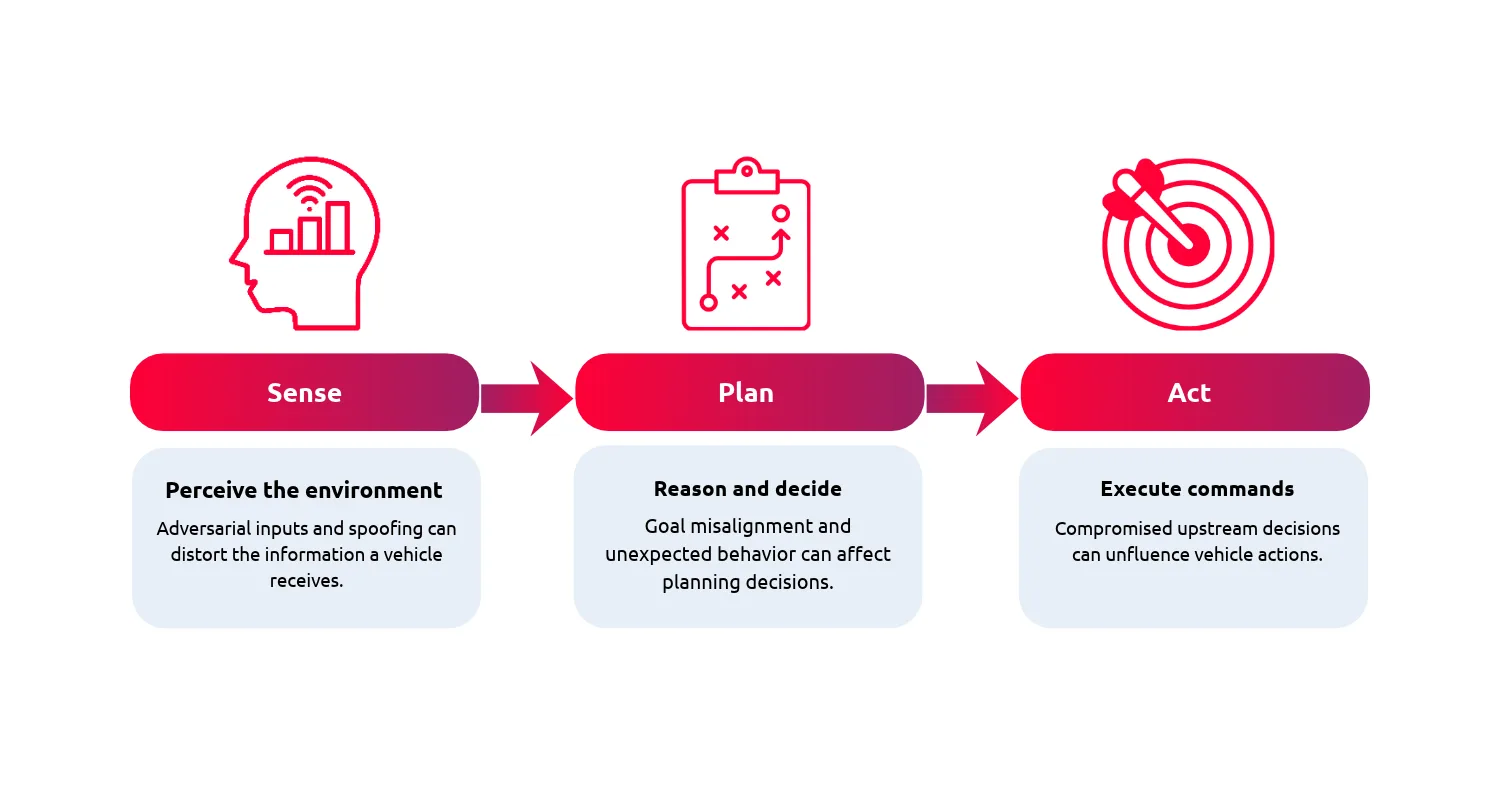
Figure 1. Threat modeling for AIDVs connects AI-related risks to vehicle behavior and consequences.
Applying this perspective means assessing the complete vehicle function, assigning responsibility across suppliers and teams, and verifying that its boundaries hold as models and integrations change.
Security for AIDVs must be designed for what the car decides, not only for what it runs.
Frequently asked questions
What cybersecurity risks do AI-defined vehicles introduce?
AIDVs add dependencies on model supply chains and on the information agents use to make decisions. Manipulated inputs, compromised training data, and prompt injection can influence behavior. The consequences depend on the vehicle functions involved, the agent’s permissions, and the controls governing its actions.
How does VicOne help protect in-vehicle AI assistants from prompt injection?
VicOne xPhinx inspects and sanitizes model inputs and outputs on-device to help protect smart-cockpit assistants and agents against prompt injection, jailbreak attempts, unsafe outputs, and sensitive data leakage. Its local processing supports protection under vehicle connectivity and computing constraints, without relying on a cloud connection to enforce security.
How does VicOne support software supply-chain security for AIDVs?
VicOne xZETA supports SBOM generation, software supplier-origin tracking, and vulnerability management. It helps OEMs and suppliers identify software dependencies and prioritize relevant vulnerabilities before and after deployment.
What framework should OEMs use to assess AI agent risks in vehicles?
ISO/SAE 21434 provides the foundational TARA methodology for automotive cybersecurity risk assessment. For AI agents specifically, that framework should be extended to cover prompt injection input channels, agent permission boundaries, and the authorization controls enforced by systems receiving agent requests. VicOne’s Sense → Plan → Act threat modeling approach connects these AI-specific risks to vehicle functions and consequences, helping OEMs identify where controls must be applied across the full decision chain.