
Physical AI challenges two assumptions common in traditional operational technology security: that critical systems can be sufficiently isolated without losing essential capabilities, and that security teams will have enough time to investigate before a cyber event produces a physical consequence. For autonomous systems, security assurance must therefore extend beyond preventing access. It must also verify that the system is still behaving as intended and support a proportionate response within the system's operating timeframe.
Key points in this blog
- Physical AI challenges two assumptions in traditional OT security: that systems can be isolated without losing essential capabilities and that people will have time to intervene before physical consequences occur.
- A cyber compromise in an autonomous robot can translate into physical action at machine speed, potentially before teams can detect the issue and intervene.
- Securing Physical AI broadens the central question from “How do we keep threats out?” to “How do we know the system is still acting as intended when full isolation is not practical?”
- Traditional controls remain essential for autonomous systems operating in physical environments, but security assurance must also include behavioral verification and proportionate responses within the system’s operating timeframe.
Which traditional security assumptions does Physical AI change?
Traditional operational technology (OT) security has often followed this logic: Isolate critical systems from external networks. Fewer connections between operational systems and outside environments meant fewer potential attack vectors.
That logic remains useful, but Physical AI complicates the traditional security model. Physical AI systems, including industrial and collaborative robots, autonomous mobile robots, drones, and other autonomous systems, perceive their surroundings, make or support decisions, and translate those decisions into physical action.
In many deployments, the boundaries of what must be secured expand, while the time between a cyber event and its physical consequences can shrink. Together, these conditions challenge traditional security assumptions about the changing role of isolation and the compressed response window.
Why is full isolation harder for some Physical AI systems?
Traditional OT security has often relied on isolation to reduce exposure. In its strictest form, this involves an air gap: a physical separation that leaves a critical system or network with no direct connection to external networks. Network segmentation and tightly controlled gateways provide other degrees of separation by restricting communication without fully disconnecting the system.
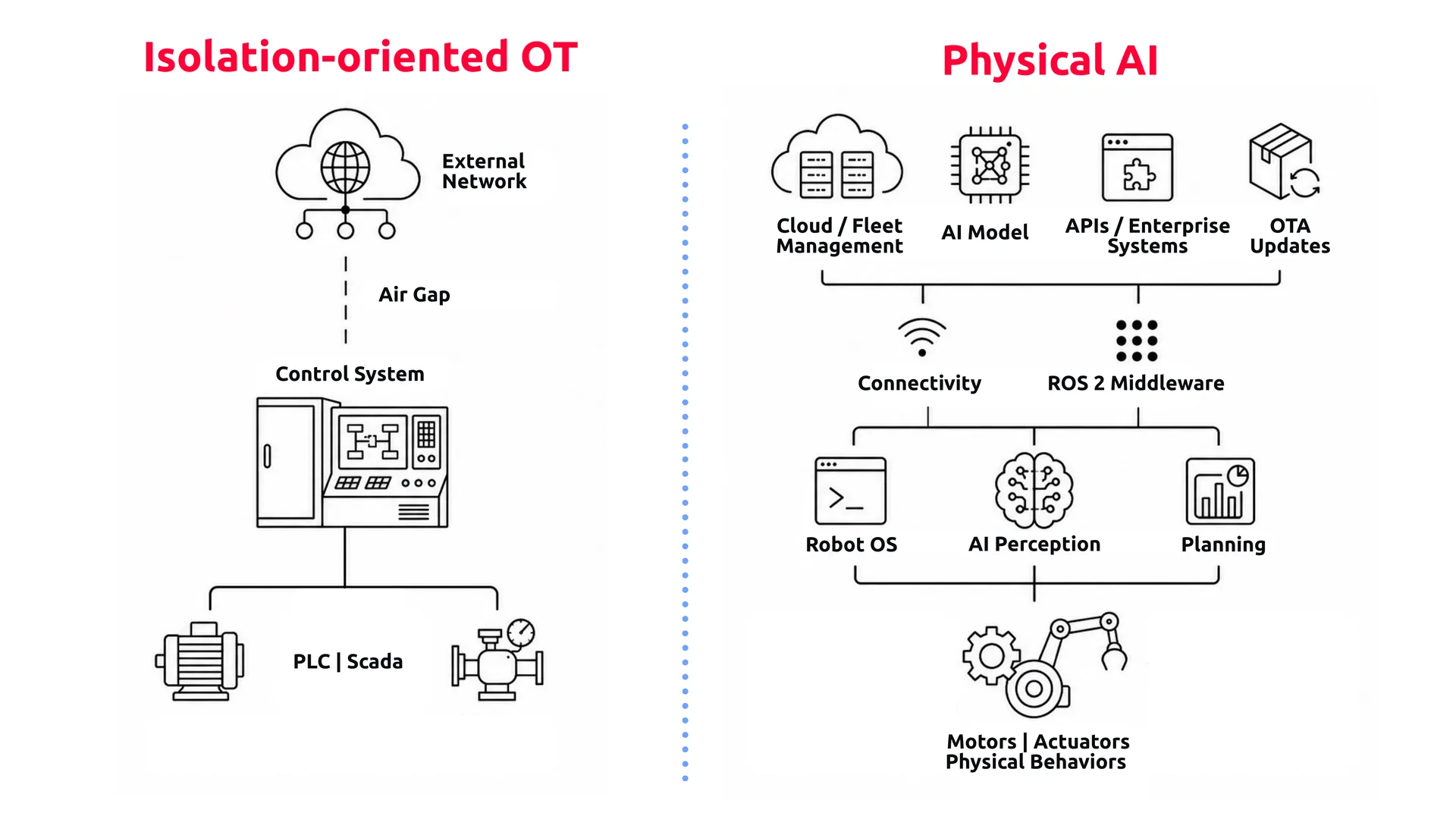
Figure 1. Isolation can effectively limit external access in OT but may be harder to implement in Physical AI systems that depend on interconnected models, services, updates, interfaces, and data.
Many Physical AI systems operate across a broader, connected architecture that can make strict isolation difficult to achieve without sacrificing core functionality. That architecture commonly includes:
- Cloud connectivity for fleet management, performance analytics, telemetry, and remote diagnostics
- Over-the-air (OTA) channels for firmware patches, security fixes, and model updates
- API integrations with enterprise platforms, third-party services, and sensor networks
- Real-time middleware such as ROS 2 and wired or wireless communication interfaces
Not every Physical AI system uses all these connections, and some can operate with limited or no external connectivity. In many deployments, however, these connections support coordination, updates, diagnostics, and ongoing management. Achieving a full air gap could mean giving up important capabilities or making the system more difficult to update, diagnose, and manage.
Isolation remains valuable, but implementing it in Physical AI can involve greater operational trade-offs. The question, therefore, is not simply whether a Physical AI system can be isolated. It is which connections are necessary and how to limit, authenticate, verify, and monitor each one.
Why can the security response window be shorter?
A traditional OT security response may follow a series of steps: A threat is detected, the alert is investigated, teams coordinate an appropriate response, and controls are applied to contain it.
While some steps may be automated, others involve human judgment, particularly when teams must validate an unfamiliar alert, assess its operational impact, coordinate across security and operational teams, or determine whether a response could affect safety and availability. The total response time varies by system and incident, but the process may take minutes or longer to complete.
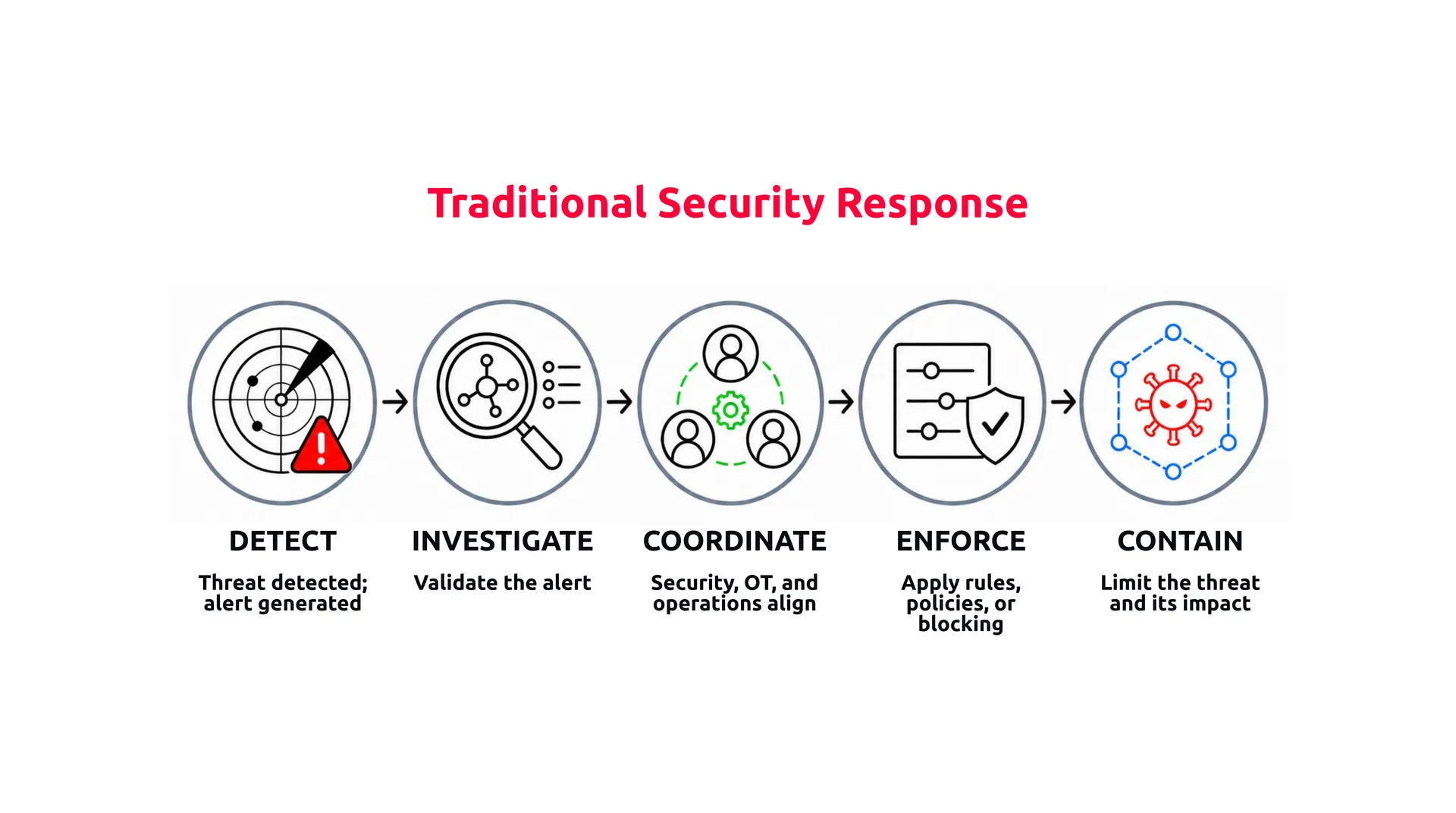
Figure 2. A simplified security response progresses through detection, investigation, coordination, enforcement, and containment.
Physical AI can compress the window between a cyber event and its potential safety consequences. A compromised input may alter perception or decision-making, trigger an actuator command, and change physical behavior within the system’s next decision or control cycle.
A recent TBS NEWS DIG report made this connection visible. During a cybersecurity demonstration, a connected quadruped robot was remotely disabled, causing it to fall and become inoperable. Speaking in the report, VicOne Japan Country Manager Akinobu Oda explained that if control of a robot is compromised, the consequences could extend beyond device disruption to property damage or physical harm.
Video 1. A TBS NEWS DIG report demonstrates how a cyberattack can disrupt a connected robot and examines why cybersecurity and operational resilience are becoming essential for Physical AI.
Source: TBS NEWS DIG, “Physical AI That Thinks and Acts on Its Own: High Expectations, but Challenges Remain as Hacking Could Lead to Loss of Control, Property Damage, or Physical Harm” (「自分で考えて動くフィジカルAI 期待の一方で課題も ハッキングで制御不能…“物を壊す・危害を加える”に繋がりかねない懸念」), September 9, 2026.
How fast can a compromise translate into physical action?
Consider three scenarios where the gap between cyber event and physical consequence is measured in milliseconds to seconds, not minutes:
Malicious API command: A robot receives a malicious API command disguised as a legitimate instruction and executes it during the next decision cycle.
Poisoned training data: A compromised vision model causes a robot to misclassify an object and act on that misclassification.
Spoofed sensor signal: A manipulated sensor signal can immediately change how the robot perceives its surroundings and influences its next action.
This does not mean every anomaly requires an automated response. It means certain protections may need to act within the system’s operating timeframe, while people retain oversight and handle investigation, coordination, and broader response decisions.
Published research shows that poisoned AI models, compromised system interfaces, and manipulated sensor inputs can each change robot behavior. In a September 2026 IEEE Spectrum article, VicOne groups the three attack paths into layers: corrupting the AI model at its source, exploiting system vulnerabilities to reach AI control, and manipulating perception and reasoning at runtime. The article cites the GoBA study from 2025, in which ordinary objects served as backdoor triggers with a 97% attack success rate and no loss of performance on clean inputs. A robot can pass validation and still act on a hidden trigger in operation.
What does Physical AI change about security assurance?
Traditional controls alone may not provide sufficient assurance when a Physical AI system depends on external connectivity and physical consequences can occur before teams can investigate and intervene. But this does not mean abandoning established security controls.
Air gaps remain valuable where feasible, while network segmentation, access controls, and boundary protections reduce exposure and limit the reach of a compromise. Monitoring provides visibility into unusual network or system behavior, and updates and patches address known security weaknesses.
For Physical AI, these controls may need to be complemented by behavioral integrity and real-time assurance measures, as evolving software, models, data, and services can shape system behavior and actions may occur within a single decision or control cycle.
Traditional security asks a central question: “How do we keep threats out?” Physical AI adds another: “How do we know the system is still acting as intended when full isolation is not practical?”
Four questions for behavioral security assurance
For Physical AI, a more complete security approach should address four connected questions:
- What can influence the robot's behavior? Map the software, models, data sources, interfaces, APIs, engineering tools, updates, and components that shape perception, decision-making, and control. This extends beyond network access to anything that can shape the robot’s actions.
- Which of these elements could be compromised or altered? Some are within the organization’s direct control, while others may come from vendors, trusted partners, open-source projects, or cloud services.
- If the robot’s behavior changes, can the deviation be detected early enough to intervene or limit its impact? Relevant indicators might include changes in model performance or confidence levels, inconsistencies in sensor data, or behavior outside expected operating bounds.
- What happens when a behavioral deviation is detected? Depending on the system and operating context, options might include rolling back an update, restricting a capability, moving to a safe operating state, requesting human intervention, or continuing under defined constraints. Teams should determine in advance which protections need to operate within the system’s timeframe and which decisions require human judgment.
Scenario: When an authorized update changes behavior
Consider a robotics company that operates collaborative robots for assembly and inspection across multiple customer facilities. The robots use computer vision for quality verification and are managed through a cloud platform. Updates are deployed automatically, and models are retrained weekly using production data.
Established controls are already in place, including encrypted communications, authentication and authorization, network segmentation, and regular security patches.
Now suppose the training pipeline is compromised upstream through a supply chain partner, cloud misconfiguration, or targeted attack. Manipulated data is introduced into the production dataset. When the model is retrained, the compromised model is deployed through the authorized update process.
From a network-security perspective, the deployment may appear legitimate. The connection is encrypted, authentication is valid, and the update arrives through the expected channel. Network and access controls may therefore not identify anything unusual.
The behavioral outcome is different: The robot begins systematically misclassifying a particular type of defect, allowing defective assemblies to pass inspection.
Video 2. In this video, VicOne LAB R7 shows how cyber risks can influence the behavior of Physical AI systems and why cybersecurity is part of their safety assurance.
VicOne LAB R7 demonstrates how cyber risks can influence the behavior of Physical AI systems and why cybersecurity is part of their safety assurance. Without behavioral monitoring, the problem may remain undetected until quality issues emerge downstream. Behavioral monitoring and post-deployment validation could reveal changes in model outputs, confidence levels, or defect-detection rates soon after rollout. Teams could then investigate whether the change was intentional, whether the training data or model was compromised, and whether to roll back the update.
Priority actions for Robotics teams
The shifts in security assumptions are not a criticism of existing practices. It's an invitation to expand security thinking in ways that align with how Physical AI systems actually operate.
For robotics manufacturers and operators, this means asking focused questions across four areas:
| Area | Questions to Consider |
| Design |
|
| Deployment |
|
| Operations |
|
| Supply Chain |
|
Table 1. Key security questions for robotics manufacturers and operators across design, deployment, operations, and supply chain
These are not new categories of thinking. But for Physical AI, they become more urgent and more specific.
Path forward: Building security assurance for Physical AI safety
Physical AI changes the conditions under which security assurance must be established. Autonomy creates situations that teams cannot fully predefine. Air-gapping can isolate a network, but it cannot isolate a robot from the people, tasks, objects, and environments that continuously shape its decisions. Nor can a one-time test anticipate every condition the robot will face after deployment.
Traditional controls remain essential. But when a manipulated input, compromised component, or altered model can become a physical action before a human can intervene, assurance must operate within the robot’s timeframe. It must continuously determine whether the robot is still behaving as intended and enable a proportionate response when it is not.
VicOne turns this into a continuous assurance flywheel. Radeis assesses whole-system cyber risk and validates in simulation how realistic attacks could push a robot beyond its intended task or safety boundaries. Rthena AI Agent translates those findings into tailored on-robot protection and behavioral baselines. In operation, Rthena Robotic SOC correlates signals across the fleet to detect behavior-affecting threats, contain the affected path, and preserve safe operation wherever possible.
Operational findings, enriched by threat research from VicOne LAB R7, feed back into the next cycle of assessment, simulation, hardening, and monitoring. Each cycle strengthens assurance as the robot, its environment, and the threat landscape evolve.
Behavior-changing risks can emerge across multiple layers of the robot stack. According to an August 2026 report in The Robot Report, 16 teams recorded 25 successful solves in VicOne’s Physical AI Safety Stress Test at the DEF CON 34 Robotic Hacking Community, which covered attack paths across AI models, perception systems, cloud and API services, robotics communications, and embedded systems. Based on that research, VicOne released the free Radeis Extension for NVIDIA Isaac Sim™, which lets developers apply curated attack scenarios to a robot model before deployment.
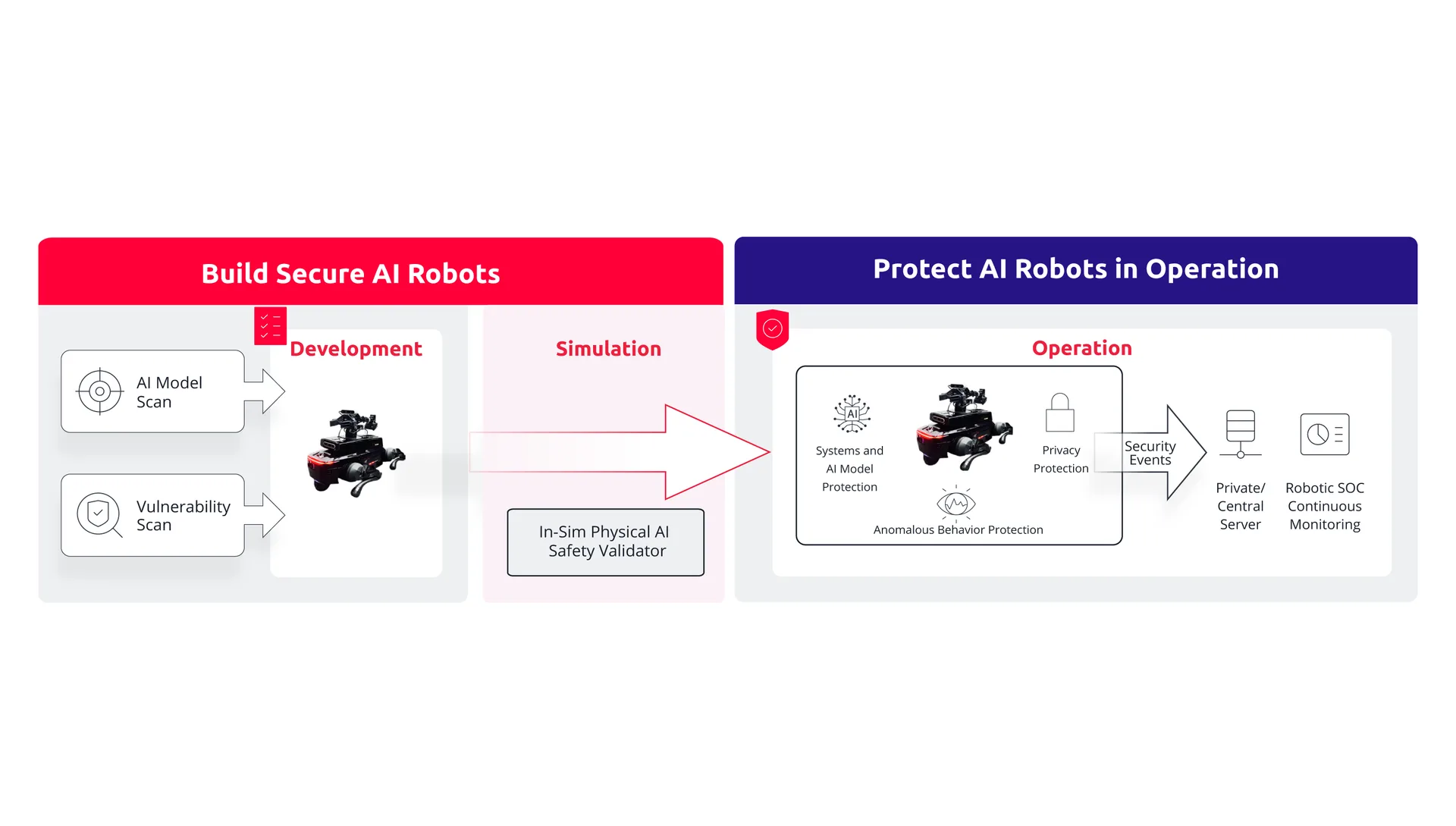
Figure 3. VicOne’s lifecycle approach combines AI model and vulnerability scanning, simulation-based validation, and continuous monitoring to help secure robots from development through operation.
Physical AI security is therefore not about achieving perfect isolation or passing a one-time test. It is about building a system of continuous assurance that learns from reality, verifies intended behavior, and adapts protection fast enough to prevent cyber risk from becoming physical harm.
Frequently Asked Questions
Does Physical AI make air gaps obsolete?
No. Air gaps still reduce network exposure, but they are not sufficient for Physical AI. Robots must interact with real-world inputs and external systems, making total isolation impractical. Security must continuously verify that robots behave as intended.
Why are traditional security controls not enough on their own?
They can verify identities, communications, access, and known software weaknesses, but they may not reveal that an authorized model, input, or command is producing unintended behavior.
What is behavioral verification?
Behavioral verification evaluates whether an autonomous system continues to perceive, decide, and act within its approved operating boundaries. It can include pre-deployment adversarial testing, post-update validation, runtime monitoring, and comparison against safety-relevant baselines. Simulation tools such as NVIDIA Isaac Sim™, when paired with VicOne Radeis, can test the effects of manipulated inputs before deployment.
Why does Physical AI require continuous security assurance?
Physical AI operates in changing environments that cannot be fully predefined. Air gaps cannot isolate robots from required real-world inputs, and one-time testing cannot cover evolving risks. VicOne Radeis validates how attacks could alter intended behavior before deployment, while Rthena protects deployed robots. LAB R7 and field insights then strengthen the next assurance cycle.
What is VicOne's central conclusion?
For Physical AI, security assurance must protect more than access to the system. It must also protect the integrity of the influences that shape behavior and provide evidence that the system remains within intended boundaries.
For a deeper look at the cybersecurity risks and defense strategies shaping autonomous robotics, download VicOne LAB R7’s white paper “Securing the Rise of AI Robots: Cyber Risks, Real-World Threats, and Defense Strategies.”
To learn more about VicOne’s approach to Physical AI security, contact VicOne.