

Protecting and Empowering
Automotive Stakeholders
Cybersecurity Solutions for OEMs and Suppliers
Request a DemoComprehensive Vehicle Cybersecurity Across the Lifecycle
VicOne provides cybersecurity solutions that protect vehicles from early design through to decommissioning. VicOne's platforms give automotive manufacturers (OEMs) and Tier 1 suppliers full visibility and control over vehicle components and software across the entire supply chain. VicOne helps connected vehicle stakeholders detect and mitigate security risks in manufacturing and supply chain systems while maintaining compliance with ISO/SAE 21434, UN R155, and other automotive cybersecurity regulations.

Centralized Threat Detection and Regulatory Compliance for OEMs
VicOne gives OEMs centralized cybersecurity visibility across complex connected vehicle ecosystems. By analyzing cross-layer data from vehicle systems, software, and cloud infrastructure, VicOne enables security teams to detect threats earlier and respond with targeted mitigations — including virtual patches and automated defenses.
VicOne solutions help OEMs build a forward-looking cybersecurity strategy aligned with UN Regulation R155, supporting manufacturers in meeting and exceeding regulatory requirements while strengthening the security of software-defined vehicles throughout their lifecycle.
Learn More — Centralized Threat Detection and Regulatory Compliance for OEMs
Comprehensive Cybersecurity for Tier 1 Automotive Suppliers
VicOne empowers Tier 1 suppliers with end-to-end solutions to secure the quality, safety, and integrity of their automotive products. Our solutions help suppliers identify potential risks, including vulnerabilities in open-source software, and implement virtual patches and other effective post-production mitigations.
With VicOne, Tier 1 suppliers can confidently demonstrate compliance with UN R155, ISO/SAE 21434, and other international automotive standards, ensuring their products meet the highest industry requirements.
Learn More — Comprehensive Cybersecurity for Tier 1 Automotive Suppliers
Secure AI-Powered Cockpits for Automotive OEMs
VicOne enables OEMs to securely innovate AI-powered cockpit systems by detecting and mitigating cybersecurity risks unique to AI-integrated vehicle environments. VicOne's solutions protect against sensitive data leaks, phishing attacks targeting in-vehicle systems, remote code execution, and exposure of personally identifiable information (PII) — helping OEMs deploy AI cockpit features without expanding the vehicle attack surface.
Learn More — Secure AI-Powered Cockpits for Automotive OEMs
Multilayered Cybersecurity for EVSE Manufacturers and Charge Point Operators
VicOne provides electric vehicle supply equipment (EVSE) manufacturers and charge point operators with multilayered cybersecurity solutions to protect charging systems from targeted attacks. VicOne's solutions continuously monitor EVSE infrastructure for vulnerabilities and malicious activity, enabling operators to identify threats early, maintain system resilience, and ensure the security of the broader EV charging ecosystem.
Learn More — Multilayered Cybersecurity for EVSE Manufacturers and Charge Point OperatorsKnow More From Our Resources
GAIN INSIGHTS INTO AUTOMOTIVE CYBERSECURITY
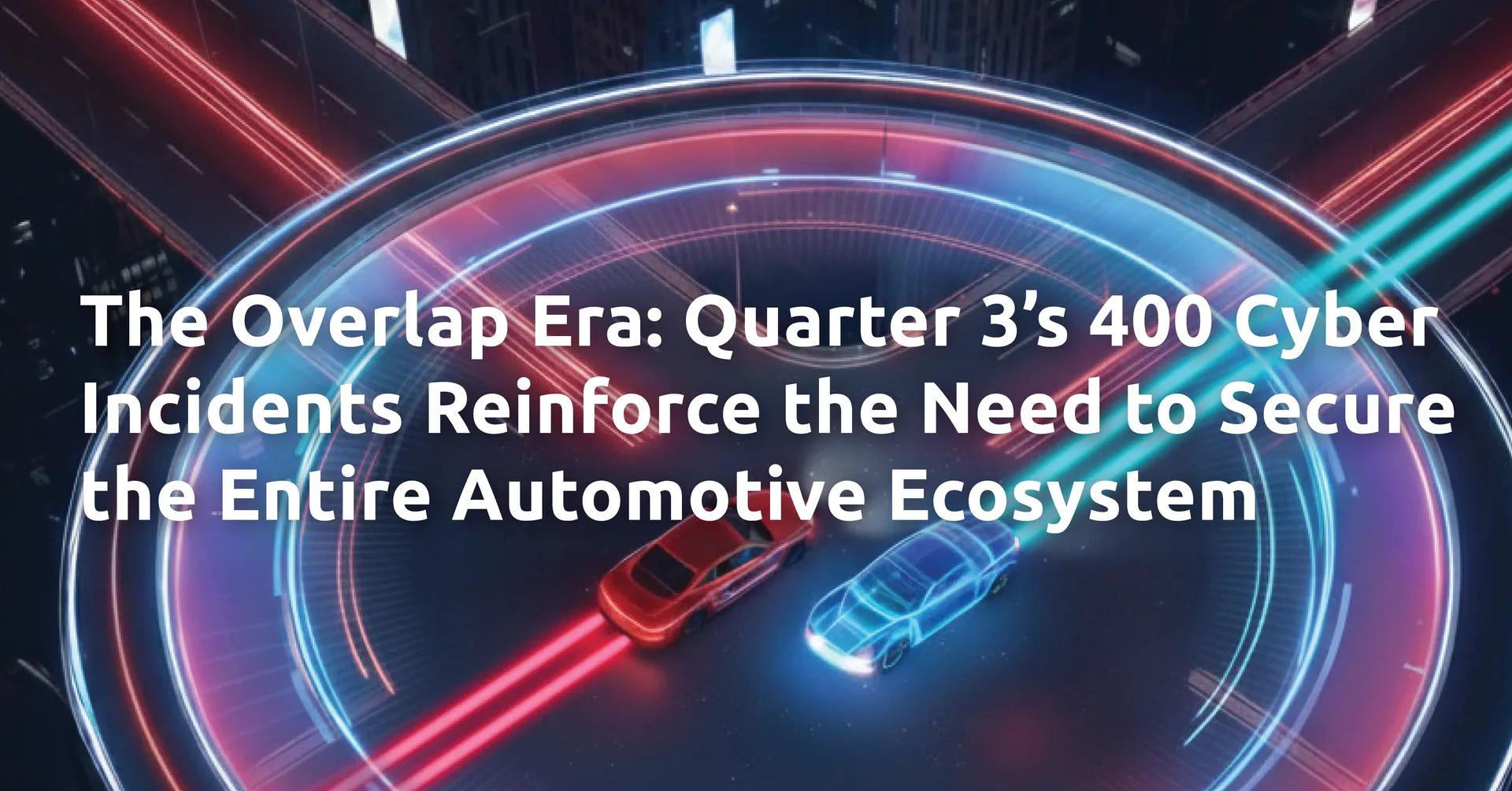
VicOne Situational Awareness Report: 400 Cyber Incidents, with In-Vehicle Systems Most Affected in Q3 2026
VicOne's Q3 2026 Situational Awareness Report tracks where automotive cyber risk shifted: in-vehicle systems overtook enterprise IT as the most affected domain, Asia recorded a 36.8% rise in observed incidents, and ransomware activity spanned the full automotive value chain across 97 incidents.
READ MORE →
Sony Patches Seven XAV-9500ES Flaws That Could Have Enabled Device Compromise
Sony patched seven XAV-9500ES vulnerabilities affecting Wi-Fi, Bluetooth, and USB. VicOne examines the attack paths, potential impact, and next steps.
READ MORE →
Why Cybersecurity Is Essential to Safety Assurance for Physical AI
Physical AI can become unsafe even without experiencing conventional failures. Safety assurance must account for cyber manipulation of the inputs, models, commands, and systems that shape robot behavior.
READ MORE →
AI Agents Can Shape the Physical World. We Can Secure Their Actions.
VicOne supports NVIDIA's Open Agent Safety Platform, extending the focus from secure AI agent decisions to the real-world actions of vehicles and robots.
READ MORE →