

Robotaxi services are moving from controlled pilots to scaled public deployment. Waymo has already expanded services across several U.S. cities, while Zoox has launched public rides in Las Vegas. WeRide has secured permits across multiple international markets, including a commercial deployment in Abu Dhabi, UAE.
As autonomous ride-hailing scales, the question is no longer where these services can operate, but how their risk surface expands. This blog examines how that risk extends beyond the vehicle into the systems that operate and sustain autonomous mobility.
Robotaxi operational incidents: real-world signals
Recent incidents offer early signals of how robotaxi systems behave under real-world conditions. Several widely shared and reported cases illustrate how these systems respond to edge cases and unexpected environments:
- An incident reported in August 2025 in Chongqing, China, involved a Baidu Apollo Go robotaxi that fell into a construction pit while carrying a passenger.
- In San Francisco, a coordinated disruption in October 2025 caused traffic congestion across multiple Waymo vehicles, followed by a December power outage that led self-driving taxis to stop operating across parts of the city.
- A report from early March in Texas, USA, shows a Waymo vehicle that appears to have moved past a lowered train crossing barrier.
These cases highlight how robotaxi systems depend on external conditions and supporting infrastructure. While performance remains consistent within expected parameters, system behavior becomes less predictable when conditions fall outside predefined scenarios.
Underground intelligence: how threat actors are tracking robotaxis
Discussion around robotaxi platforms is not limited to public incidents. VicOne’s analysis of forums and encrypted messaging channels shows that autonomous mobility ecosystems are increasingly visible to a wider range of online actors.
VicOne identified more than 8,000 records referencing brands in this space, with 2,334 directly related to robotaxi deployment. Waymo and Tesla dominate overall discussion volume, with Tesla generating more robotaxi-specific mentions, likely driven by speculation around its Full Self-Driving (FSD) evolution into a commercial fleet.
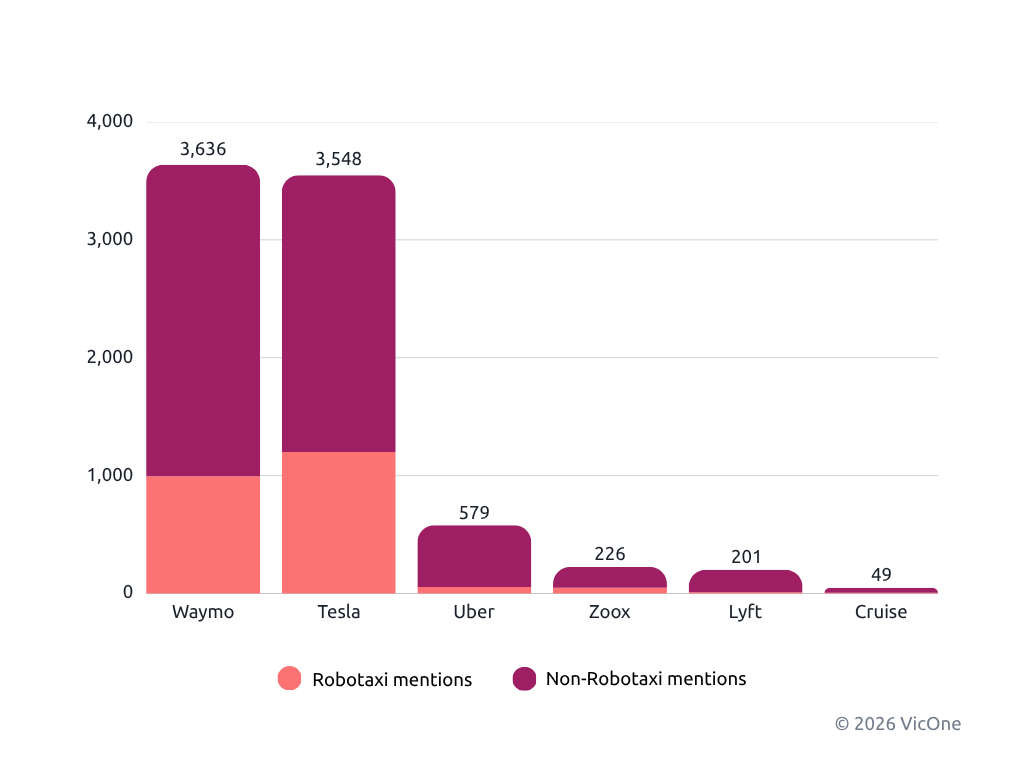
Figure 1. Discussion is concentrated among a small number of dominant platforms. Additional activity across other ecosystem players, including Pony.ai, AutoX, Aurora, Nuro, May Mobility, and Motional, is not shown in this graph. Source: VicOne analysis.
These discussions are also becoming more operational in focus. Waymo is frequently associated with ride-hailing access, invite mechanisms, and remote human intervention, while WeRide appears in supply and fleet-related contexts such as vehicle modification, maintenance, and support. Other platforms, including Uber, Lyft, DiDi, and providers such as Zoox, Cruise, Baidu Apollo Go, and niche Level 4 operators, also feature across these conversations.
Based on this underground intelligence, attention has shifted from general interest in autonomous driving to detailed mapping of the ecosystem, including operations, platform dependencies, and supply chains. This interest is not limited to observation. Underground actors are increasingly attempting to gain access to platform systems, backend infrastructure, and supply chain networks.
Supply chain exposure in autonomous vehicle programs
The risks facing robotaxi platforms extend into the supply chain that supports vehicle production, integration, and deployment.
One example involves a major Tier-1 automotive supplier supporting autonomous vehicle programs. In underground forums, a threat actor claimed to have gained access to internal systems, including virtual private network (VPN) credentials, domain access, and engineering environments such as enterprise resource planning (ERP) and computer-aided design (CAD) platforms.
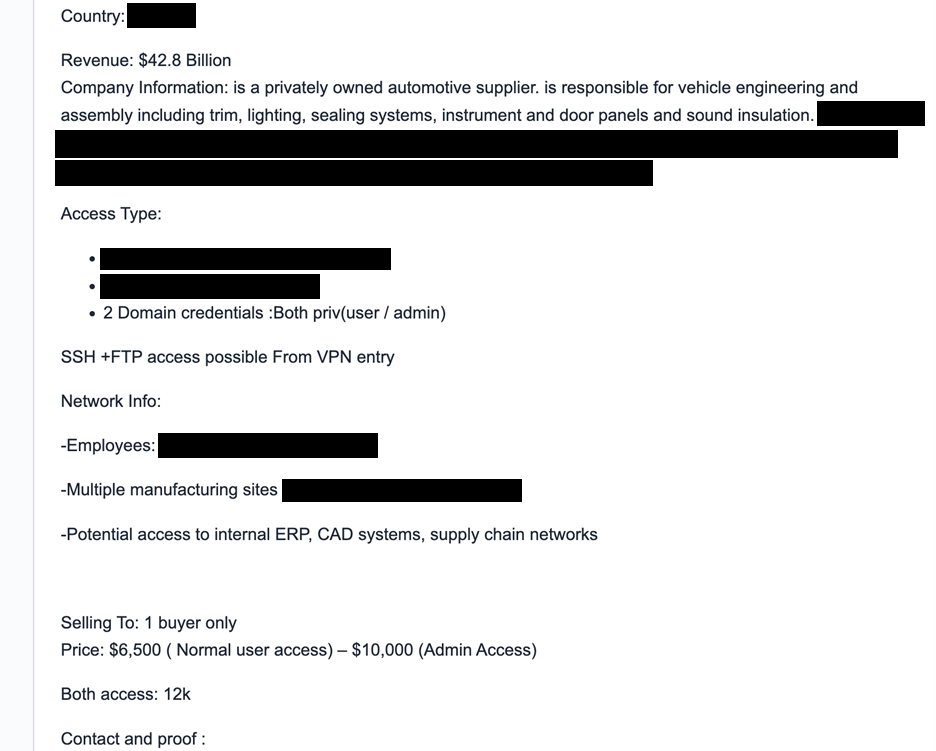
Figure 2. Example of an underground forum listing advertising access to a Tier-1 automotive supplier. Details are redacted. Source: VicOne analysis.
This type of supply chain exposure does not immediately translate into remote compromise of vehicle fleets. However, access to engineering data can reveal details such as sensor placement, wiring architecture, and integration design. This lowers the barrier for reverse engineering, targeted research, and future exploitation.
Platform and backend risks in robotaxi ecosystems
Robotaxi systems rely heavily on cloud platforms, mobile applications, and backend services, introducing an additional layer of risk beyond the vehicle.
Two examples illustrate how this exposure manifests:
- A ride-hailing platform where attackers reportedly claimed access to backend systems, including customer data, encrypted credentials, and API keys linked to third-party services.
- A consumer dashcam platform that reportedly aggregated large volumes of video data from connected devices, effectively creating a distributed surveillance network.
These examples highlight a broader pattern. Even when autonomous driving systems function as intended, the surrounding platform infrastructure introduces additional exposure points. Weak identity and access management, insecure API integrations, and misconfigured cloud services can create entry points that affect not just data confidentiality, but also operational integrity.
Conclusion
Cyber risk in robotaxis is no longer confined to the vehicle itself. It spans the infrastructure that coordinates fleets, the suppliers that enable production, and the platforms that manage user interaction and data.
This aligns with key findings from the VicOne 2026 Automotive Cybersecurity Report, which predicts that as mobility platforms become more centralized, a single compromise in fleet management systems or backend orchestration layers can disrupt operations at scale.
For robotaxi operators and their stakeholders, the challenge extends beyond securing individual driverless vehicles. It requires managing risk across a distributed ecosystem, where vehicles, platforms, and supply chains are tightly integrated.
VicOne, an automotive cybersecurity company serving OEMs and Tier 1 suppliers, tracks these risks across the full vehicle ecosystem — from in-vehicle detection to backend threat intelligence.