

When Edge AI makes decisions in the cockpit, you need more than LLM-based guardrails

Latency
Cloud enforcement slows inference and degrades a smooth cockpit experience

Resource Overhead
Heavy guardrails consume memory and impact system performance

Integration Friction
Security not designed for edge AI delays SOP and struggles to keep up with emerging attack techniques
xPhinx: Secure Edge AI Interaction Without Delay or Overhead
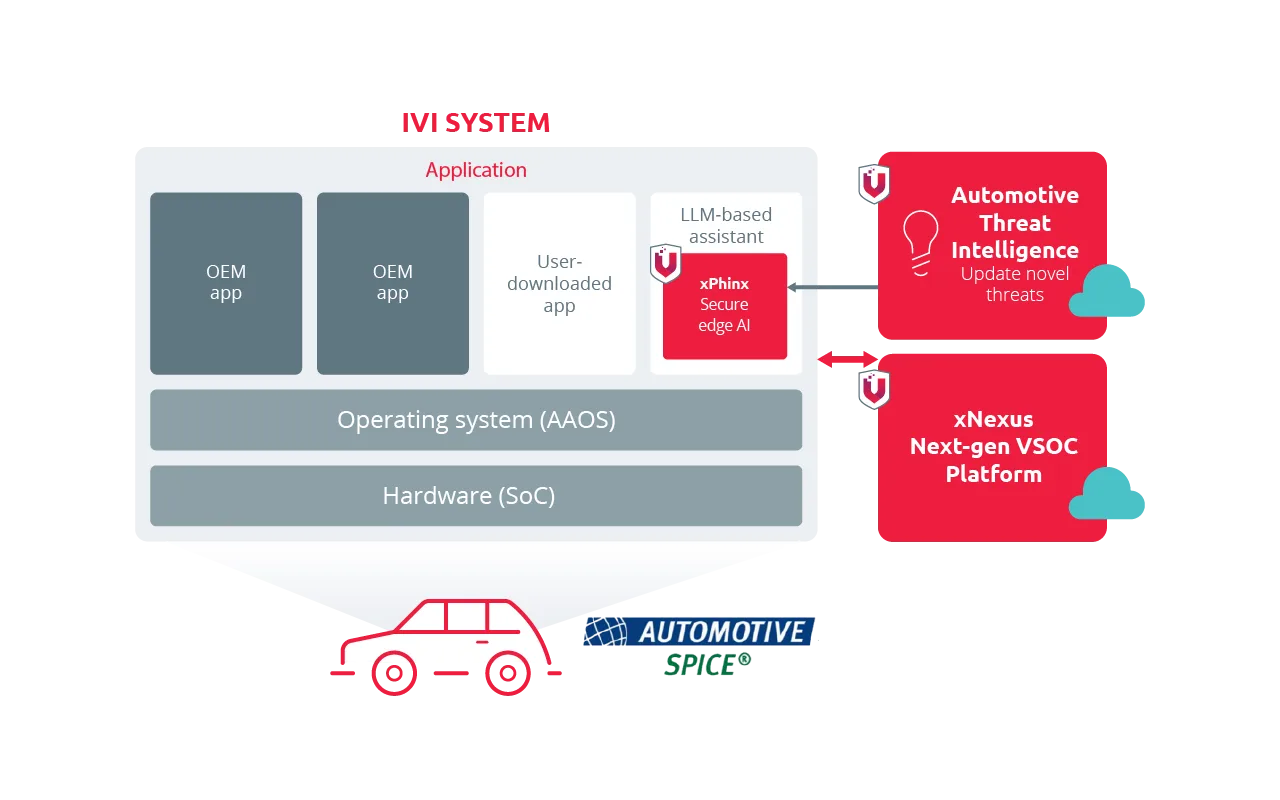

Risk-based AI Security Protection for In-Vehicle Edge AI
xPhinx protects in-vehicle edge AI and AI agents from prompt injection, jailbreak, unsafe behaviors, and data leakage, without slowing down AI intelligence cockpit interaction. Powered by automotive threat intelligence, xPhinx keeps pace with evolving prompt attacks and jailbreak techniques, inspecting and sanitizing LLM inputs and outputs to stop manipulated or unsafe behavior where AI decisions are made.

Enforce AI Security With Minimal Performance Impact
Unlike LLM-based guardrails, xPhinx is purpose-built for in-vehicle edge AI models (LLM/VLM). Its lightweight architecture operates directly on the device, achieving up to 70%* faster execution and up to 90%* lower memory usage. All without retraining, modifying, or upgrading existing AI models.

Context-Aware, Tiered Protection for In-Vehicle AI
xPhinx uses a dual-layer, risk-aware design: a lightweight first layer runs continuously, while deeper intent analysis is activated only when higher-risk behavior is detected. This approach delivers strong AI security without impacting AI application performance across diverse smart-cockpit applications. All VicOne edge software aligns with the ASPICE CL2 product and project requirements.
Built for Vehicles
xPhinx vs. LLM-Based Guardrails
Cloud and LLM-based guardrails were designed for content and service safety, not for an edge AI-driven smart cockpit that directly influences vehicle behavior and seamless user interaction.
| LLM-Based Guardrails | xPhinx | |
|---|---|---|
| Designed for Edge AI smart cockpit | Limited; high cost & latency | Yes |
| Privacy and data residency | Data send to cloud guardrail | 100% local processing |
| Resource requirement | High (GPU/NPU), substantial RAM; not for Edge AI | Low; design for Edge AI |
| Availability | Need internet connection | 100% offline |
| User experience impact | Yes | User undetectable |
| Continuously automotive and AI attack techniques updated | Limited, no dedicated security threat intelligence | Supported by VicOne automotive threat intelligence |
xPhinx FAQ
What is VicOne xPhinx?
Why can't cloud-based AI guardrails protect in-vehicle AI?
How does xPhinx protect in-vehicle AI without slowing it down?
What AI threats does xPhinx defend against?
Does xPhinx require changes to existing AI models?
Can xPhinx be deployed across different AI frameworks and operating systems?
How does xPhinx support automotive compliance?
Know More From Our Resources
GAIN INSIGHTS INTO AUTOMOTIVE CYBERSECURITY
Sony Patches Seven XAV-9500ES Flaws That Could Have Enabled Device Compromise
Sony patched seven XAV-9500ES vulnerabilities affecting Wi-Fi, Bluetooth, and USB. VicOne examines the attack paths, potential impact, and next steps.
READ MORE →
Why Cybersecurity Is Essential to Safety Assurance for Physical AI
Physical AI can become unsafe even without experiencing conventional failures. Safety assurance must account for cyber manipulation of the inputs, models, commands, and systems that shape robot behavior.
READ MORE →
AI Agents Can Shape the Physical World. We Can Secure Their Actions.
VicOne supports NVIDIA's Open Agent Safety Platform, extending the focus from secure AI agent decisions to the real-world actions of vehicles and robots.
READ MORE →
Looking Beyond the Mythos Era: If AI Can Read Firmware, What Does Protection Mean Now?
Part 2 of 2: AI-driven binary analysis is forcing a rethink of automotive firmware protection. Part 1 covered how AI shortens PoC-to-exploit timelines.
READ MORE →