



VicOne Research Estimates Tens of Billions in Automotive-Cyberattack Losses, Plus Rising Vulnerabilities and Growing AI, EV and Dark Web Risks
“Shifting Gears: VicOne 2025 Automotive Cybersecurity Report” reveals value of proactive
and comprehensive cybersecurity as transformative era in mobility continues to unfold
DETROIT and TOKYO — VicOne, an automotive cybersecurity solutions leader, today announced in-depth analysis revealing concerning signs for the global automotive industry in 2025, despite promising law enforcement success around cybersecurity in the last year. “Shifting Gears: VicOne 2025 Automotive Cybersecurity Report,” which is available to download, explores the rapidly evolving landscape of automotive cybersecurity, delivering actionable insights and emerging trends and data points:
- Cyberattacks on the automotive industry from 2022 to 2024 resulted in tens of billions of dollars in estimated damages from ransomware, data breaches, and operational disruptions.
- Automotive vulnerabilities reached an all-time high in 2024. More than 77 percent of automotive vulnerabilities were found on onboard or in-vehicle systems. Fresh challenges are emerging in electric vehicle (EV) charging, operating systems, and fleet management.
- While artificial intelligence (AI) enhances in-car features and operational efficiency, it also introduces new attack vectors like prompt injection and compromised training data that challenge traditional security methods.
- Rapid EV adoption has exposed critical weaknesses in charging infrastructure — from unsecure payment protocols to outdated communication standards — potentially affecting both vehicles and power grids.
- Cybercriminals are leveraging dark web channels to exchange sophisticated exploit techniques and stolen vehicle data, raising the stakes for manufacturers and consumers alike.
“We are amid a transformative era of mobility, as innovations such as AI are helping automakers differentiate their vehicles, accelerate time to market, and enhance customer experience,” said Max Cheng, chief executive officer of VicOne. “A proactive, multilayered approach to cybersecurity across all levels of the supply chain will help the automotive industry stay ahead of evolving threats and thrive in pursuing the unprecedented opportunities ahead.”
From the ongoing shift toward software-defined vehicles (SDVs) and AI-enhanced features to the evolving landscape of EV charging and the escalating vulnerabilities in in-vehicle systems, the automotive industry is shifting to high gear into unknown territories.
A total of 215 automotive cybersecurity incidents were recorded in 2024, highlighting a consistent threat throughout the year. Cloud and back-end vulnerabilities were the most frequent attack vectors and typically involved ransomware attacks, data breaches, and social engineering or phishing attacks. Vehicle hijacking, supply chain attacks, keyless entry exploits and vehicle electronics virtualization threats mostly involved onboard systems and over-the-air (OTA) vulnerabilities.
Supply chain attacks are growing more complicated and devastating, as criminals in the last year clearly targeted suppliers and third-party providers of components as weak links to exploit in the tightly integrated industry. A ransomware attack on a dealership software provider in June 2024, for example, disrupted operations at more than 15,000 North American dealerships.
Analysis of criminal underground message exchanges shows that multilayered, widespread attacks on automobiles and the industry are growing only more possible and likely. The pieces are in place for a transition from today’s manual, car-modding hacks to more harmful and larger-scale attacks such as user impersonation and account thefts.
Meanwhile, the total count of automotive-related vulnerabilities (“CVEs”)s published in 2024 reached 530, another annual gain and just two short of twice as many as in 2019. The sharp rise in vulnerabilities highlights the rapid growth in both the automotive attack surface and complexity of automotive systems. Vulnerabilities began shifting from chipset-related issues to CVEs involving in-vehicle infotainment (IVI) platforms and operating systems, in addition to EV charging infrastructure. Indeed, at the world’s largest zero-day vulnerability discovery contest, Pwn2Own Automotive 2025, which took place at Automotive World from Jan. 22 to 24, 2025, in Tokyo, top-tier security researchers from 13 countries discovered 49 unique zero-day vulnerabilities across primarily IVI and EV charging systems.
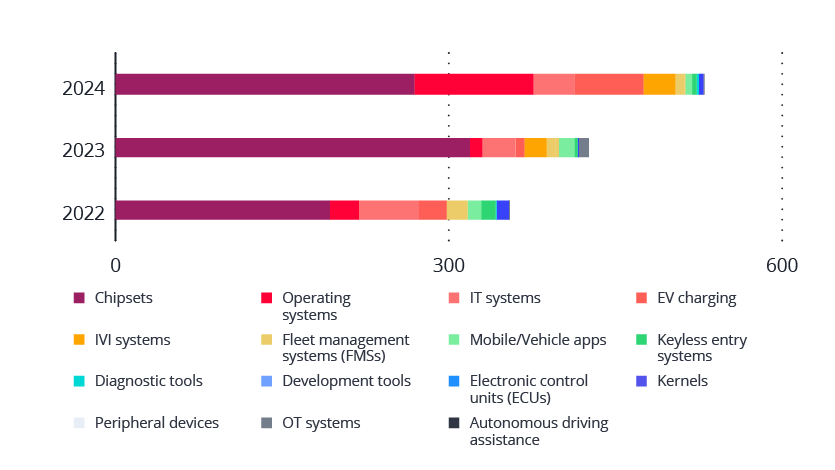
Figure 1. Distribution of automotive vulnerabilities published each year from 2022 to 2024 by affected system or component
Increased adoption of AI is creating unprecedented opportunities but also significant new operational, financial and strategic risks for automakers. “AI-enabled systems may encounter misuse and abuse throughout their lifecycle due to factors such as over- or under-utilization, operating outside of operational envelopes, and malice,” reads a September 2024 US Department of Transportation white paper, “Understanding AI Risks in Transportation.” “Humans may either be a source of these vulnerabilities or help prevent them depending on their role in the system.”
The large language models (LLMs) informing generative AI are especially attractive targets for cybercriminals, given their dependency on critical enterprise data, utilization of hard-to-control self-learning, and propensity for errors. Unsecure plug-in designs, improper output handling, and adversarial attacks are among the prominent operational risks to be addressed in the adoption of AI. In addition, significant strategic risks (seismic shifts in governance) and financial risks (hard-to-assess liability, risk management, and branding issues) are presenting themselves.
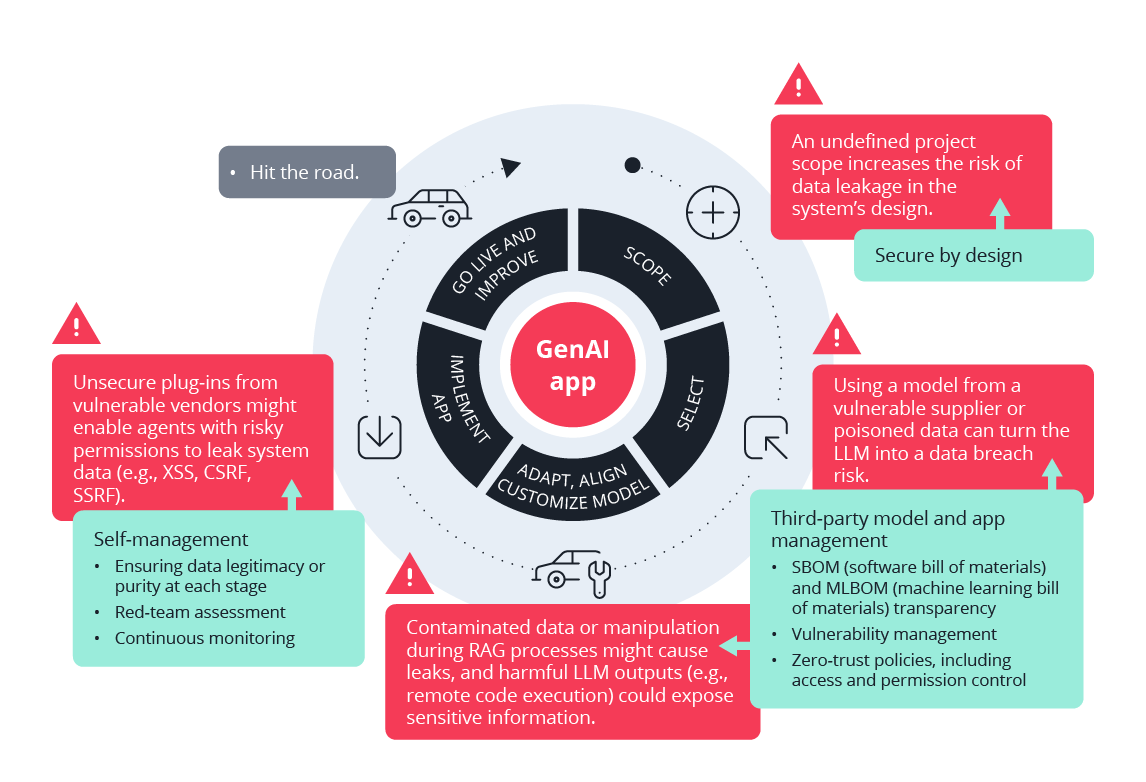
Figure 2. Security risks in the GenAI application development lifecycle and mitigation strategies
For more information on the critical factors shaping today’s automotive cybersecurity landscape and strategies to safeguard the future of connected mobility, please download “Shifting Gears: VicOne 2025 Automotive Cybersecurity Report.”
Founded and singularly focused on spearheading innovation in vehicle cybersecurity, VicOne, the market leader of automotive cybersecurity, provides the most advanced and comprehensive solutions to the automotive industry and galvanizes collective expertise from the sector’s broadest cast of best-of-breed partners. OEMs and suppliers trust VicOne’s purpose-built solutions to stay ahead of evolving threats and safeguard vehicles, drivers, and sensitive data.
For more information on VicOne’s holistic approach to cybersecurity — spanning software, hardware and supply chain ecosystems — please visit https://vicone.com/solutions.
About VicOne
With a vision to secure the vehicles of tomorrow, VicOne delivers a broad portfolio of cybersecurity software and services for the automotive industry. Purpose-built to address the rigorous needs of automotive manufacturers and suppliers, VicOne solutions are designed to secure and scale with the specialized demands of the modern vehicle. As a Trend Micro subsidiary, VicOne is powered by a solid foundation in cybersecurity drawn from Trend Micro’s 30+ years in the industry, delivering unparalleled automotive protection and deep security insights that enable our customers to build secure as well as smart vehicles. For more information, visit vicone.com.
Media Contact
Ling Cheng
ling_cheng@vicone.com